Purchasing a home in New Jersey requires a highly strategic financial approach. Due to some of the highest property tax rates in the nation, calculating a monthly housing statement involves much more than simply tracking principal and interest. An accurate assessment requires analyzing local municipal liabilities, localized homeowners insurance benchmarks, and conventional debt structures. This comprehensive guide outlines the underlying mathematics, statutory regulations, and structural escrow components required to accurately deploy and utilize a professional grade New Jersey Mortgage Calculator.
“Calculations verified by Daniel W. Foster, GIS Mapping & Public Records Specialist. Updated, [Current 5/2026]
New Jersey Mortgage Calculator
Use this free calculator to determine your monthly mortgage payment in New Jersey — including principal & interest, property taxes, homeowners insurance, PMI and HOA fees.
Enter your home details and click Calculate to see your monthly payment breakdown.
1. The Core Components of a New Jersey Mortgage Payment (PITI)
A reliable New Jersey mortgage calculation relies on the traditional PITI model (Principal, Interest, Taxes, and Insurance). In the Garden State, omitting any single variable can significantly distort financial projections. The foundational calculation framework relies on the following structural variables.
- Principal.
The direct balance reduction applied to the outstanding loan amount. - Interest.
The debt servicing fee determined by the financial institution, calculated based on the amortized balance. - Property Taxes (T).
Statutory assessments collected by municipal tax collectors to fund local school districts, county infrastructure, and municipal services. - Homeowners Insurance (I).
Hazard insurance policies required by lenders to protect the underlying collateral asset from structural loss.
The Conventional Amortization Equation
To accurately compute the fixed monthly Principal and Interest (M), the algorithmic backend of the calculator must execute the standard fixed-rate amortization formula.
Where
M = The definitive monthly principal and interest obligation.
P = The total principal loan volume (Purchase Price minus Down Payment).
r = The periodic monthly interest rate (Annual Percentage Rate divided by 12 months).
n = The comprehensive number of monthly payments across the lifecycle of the debt (e.g., 360 payments for a standard 30 year fixed term).
2. Managing New Jersey’s Property Tax Reality
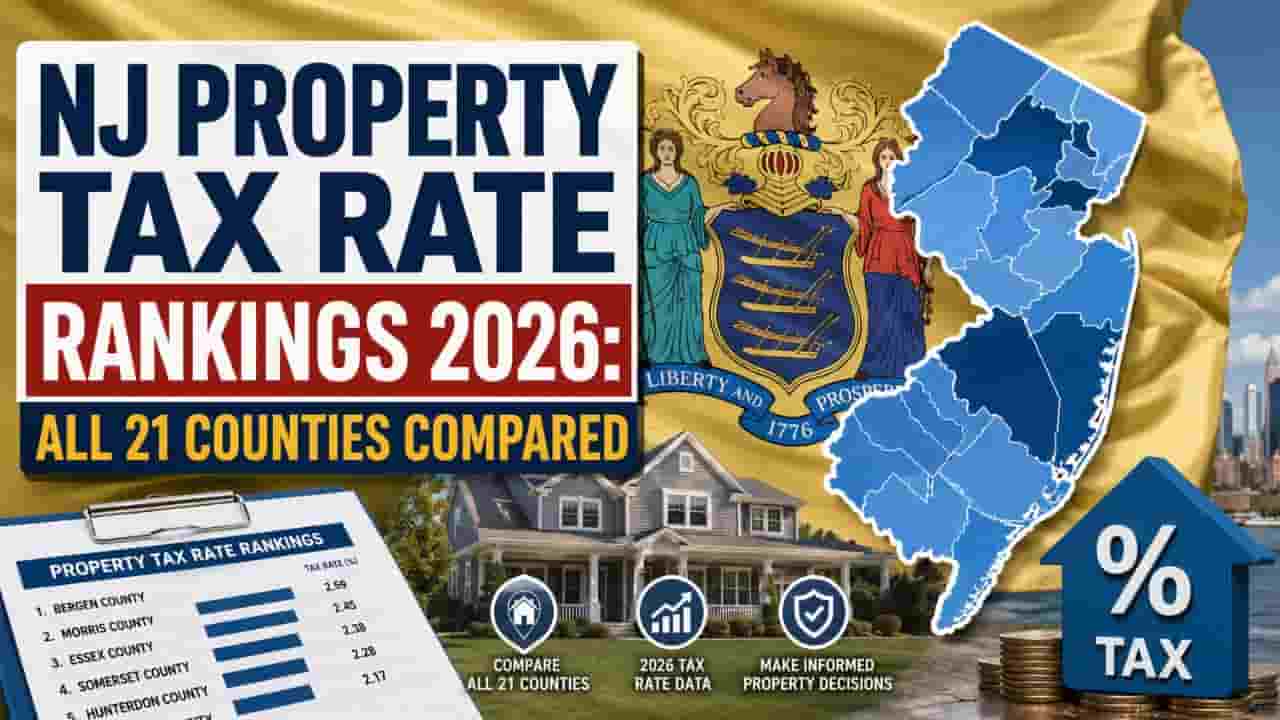
New Jersey maintains the highest effective property tax rate in the United States, averaging over 2.4% of an asset’s assessed market value. Consequently, an accurate New Jersey mortgage tool cannot rely on nationwide averages. It must integrate county level data points.
Property taxes are determined locally based on the municipal tax rate and the property’s assessed value. These funds are typically escrowed by the mortgage servicer, who divides the annual obligation into twelve equal parts and adds them directly to the monthly payment.
County by County Property Tax Benchmarks
| New Jersey County Name | Average Effective Tax Rate | Annual Tax on a $500,000 Property |
| Atlantic County | 2.50% | $12,500 |
| Bergen County | 2.20% | $11,000 |
| Burlington County | 2.43% | $12,150 |
| Camden County | 3.41% | $17,050 |
| Cape May County | 1.05% | $5,250 |
| Cumberland County | 2.84% | $14,200 |
| Essex County | 3.01% | $15,050 |
| Gloucester County | 3.21% | $16,050 |
| Hudson County | 2.14% | $10,700 |
| Hunterdon County | 2.44% | $12,200 |
| Mercer County | 2.91% | $14,550 |
| Middlesex County | 2.44% | $12,200 |
| Monmouth County | 2.15% | $10,750 |
| Morris County | 2.24% | $11,200 |
| Ocean County | 1.64% | $8,200 |
| Passaic County | 2.91% | $14,550 |
| Salem County | 3.24% | $16,200 |
| Somerset County | 2.19% | $10,950 |
| Sussex County | 2.64% | $13,200 |
| Union County | 2.93% | $14,650 |
| Warren County | 2.62% | $13,100 |
Data Source. New Jersey Department of Taxation, Division of Taxation Property Administration annual reports.
Expert Technical Note on Assessment Ratios. Municipalities across New Jersey execute regular updates to their local tax books. The assessed value used for calculating property taxes may differ from the property’s fair market value. Advanced calculators should allow users to input an exact annual dollar amount or choose a specific county level percentage to ensure accurate projections.
3. Secondary Escrow Components and Lending Charges
Beyond local real estate taxes, a comprehensive mortgage calculation must account for risk mitigation premiums and regulatory fees specific to the regional landscape.
Private Mortgage Insurance (PMI)
For conventional loans where the buyer’s down payment is under 20% of the purchase price, lenders require Private Mortgage Insurance (PMI). PMI protects the lender against default risk and typically costs between 0.3% and 1.5% of the original loan balance annually. This premium is collected monthly and automatically terminates once the principal balance drops to 78% of the original home value.
Homeowners Insurance Anchors
New Jersey’s varied geography alters hazard insurance requirements. Inland suburban properties generally face standard premium tiers. However, coastal zones such as Monmouth, Ocean, Atlantic, and Cape May counties often require specialized flood insurance via the National Flood Insurance Program (NFIP) alongside traditional windstorm deductibles to cover coastal storm vulnerabilities.
4. Step by Step Practical Calculation Workflow
To accurately map out the financial realities of buying a home in New Jersey, users should follow this systematic, expert approved approach.
- Establish the Total Baseline Purchase Price.
This serves as the initial valuation point for both the loan structure and future property tax assessments. - Deduct the Initial Down Payment.
Conventional parameters require 20% to avoid PMI entirely, while FHA structures permit down options as low as 3.5%. The remaining amount forms the baseline principal (P). - Input Current Institutional Interest Rates.
Apply prevailing market interest rates based on the borrower’s credit profile and structural selection (e.g., 30 year fixed vs. 15 year fixed). - Factor in Regional Property Taxes.
Utilize specific municipal or county tax sheets rather than broad national metrics to avoid underfunding the escrow account. - Include Standard Hazard Premiums and HOA Dues.
Account for regional insurance rates and any applicable Homeowners Association maintenance assessments.
5. Optimizing the Financial Strategy, Reducing Monthly Obligations
Prospective buyers can use several practical strategies to lower their monthly mortgage payment and long term borrowing costs in New Jersey:
- Target a 20% Down Payment.
This eliminates the monthly PMI premium completely, reducing the recurring escrow burden. - Verify Statutory Tax Exemptions.
The New Jersey Department of Taxation provides specific relief programs, such as the ANCHOR Program and the Senior Freeze (Property Tax Reimbursement), which lower the net tax obligation for eligible households. - Consider Loan Term Variations.
A 15 year fixed rate framework increases the monthly principal obligation but dramatically reduces total interest costs over the life of the loan.
By integrating specific regional tax data, standard amortization formulas, and accurate escrow requirements, a localized New Jersey Mortgage Calculator provides consumers with a highly accurate, professional grade financial planning tool that eliminates costly surprises at the closing table.
Conclusion
Accurate financial forecasting in the Garden State demands more than a generic loan amortization schedule. Utilizing a specialized New Jersey mortgage calculator is the only reliable method to structurally unify baseline interest matrices with our complex, hyper localized municipal property tax rates. By stress testing your complete PITI footprint and escrow variables before underwriting, you effectively mitigate closing table liabilities, stabilize long term debt to income limits, and secure structural equity with absolute transactional confidence.
FAQs
What components make up a standard New Jersey mortgage payment?
A standard New Jersey monthly payment relies on PITI, Principal, Interest, local municipal Property Taxes, and Homeowners Insurance premiums escrowed monthly by your lender.
Why are property taxes so high on a New Jersey mortgage calculation?
New Jersey holds the highest average effective property tax rate in the US (over 2.4%). Calculators must use exact local municipal tax assessments to remain accurate.
How can I avoid paying Private Mortgage Insurance (PMI) in NJ?
To eliminate monthly Private Mortgage Insurance (PMI) premiums from your loan amortization schedule, you must provide an initial down payment of at least 20%.
Do New Jersey property tax relief programs affect monthly mortgage payments?
Yes. State programs like ANCHOR and Senior Freeze provide property tax relief, effectively lowering the annual tax obligation managed within your mortgage escrow account.
Is specialized hazard insurance required for coastal New Jersey homes?
Yes. Homes in coastal counties (e.g., Ocean or Monmouth) often require secondary NFIP flood insurance policies and windstorm deductibles alongside standard homeowners insurance.
How does a 15 year fixed loan compare to a 30 year mortgage in NJ?
A 15 year fixed mortgage requires a higher monthly principal payment but secures lower institutional interest rates, saving thousands in total long term financing costs.