In New Jersey, few phrases strike more anxiety into the hearts of homeowners than “Municipal Revaluation”. When a notice arrives in the mail from your local assessor or a firm like Professional Property Appraisals, the immediate question is almost always: How much will my taxes go up? However, for a 2026 homeowner, understanding the mechanics of a revaluation is the key to protecting your financial interests. Despite popular belief, a revaluation is not a tax hike it is a mandatory “reset” of the tax burden to ensure equity across the township. This professional guide provides a technical breakdown of the NJ revaluation process, the 1/3 Rule, and how to handle a higher assessment without panic.
What is a Municipal Revaluation?
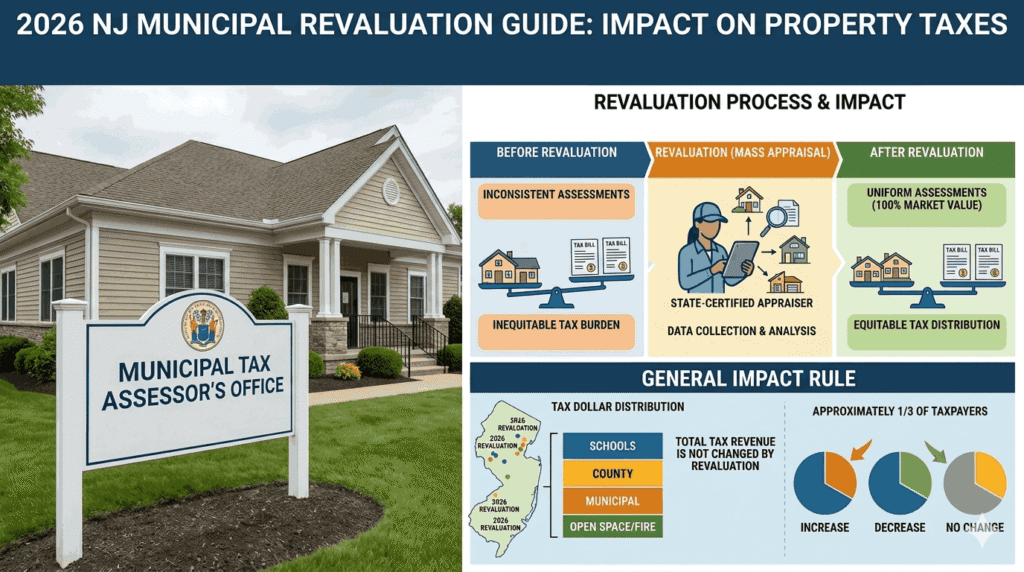
A revaluation is a program undertaken by a municipality to appraise all real property within the taxing district according to its full and fair market value. Over time, property values in different neighborhoods grow at different rates. Without a revaluation, a homeowner in a booming neighborhood might be paying the same taxes as someone in a stagnant area, which violates the New Jersey Constitution’s requirement for uniform taxation.
Revaluation vs Reassessment, The Difference
- Revaluation
Conducted by an outside professional appraisal firm hired by the town. It involves a physical inspection of every property (interior and exterior). - Reassessment
Often performed in house by the local tax assessor. It is more frequent and typically occurs in towns that keep their data updated annually to stay at 100% of market value.
The “1/3 Rule” of NJ Revaluations
The most critical concept for any homeowner to grasp is that revaluations are revenue neutral. The municipality does not collect more total money because of a reval; instead, it changes how the “pie” is sliced.
How the Tax Burden Shifts Table
| Property Status | Assessment Change | Likely Tax Impact |
| Below Average Growth | Assessment rises less than town average. | Tax Decrease |
| Average Growth | Assessment rises exactly at town average. | No Change |
| Above Average Growth | Assessment rises more than town average. | Tax Increase |
The General Rule of Thumb. Historically, in a New Jersey revaluation, roughly one third of residents see a tax increase, one third see a decrease, and one third remain flat.
The 2026 Revaluation Process, Step by Step
If your township (such as Ewing, Little Silver, or New Providence) is currently undergoing a revaluation, here is the official workflow you can expect.
1. The Introduction Letter
You will receive a formal letter from the municipality announcing the revaluation and identifying the appraisal firm.
2. Physical Inspection (The Field Visit)
An inspector with a photo ID badge will visit your home to record building dimensions, materials, and interior features (number of bathrooms, finished basements, etc.).
- Tip
You are not legally required to let them in, but if you refuse, the appraiser will “estimate” the interior. This usually results in a higher than actual assessment, as they will assume you have a finished basement or high end upgrades.
3. Market Analysis
The firm studies recent sales in your neighborhood from the prior October 1st (the statutory valuation date) to estimate what your home would realistically sell for in an open market.
4. Notice of Value (NOV)
Between November and February, you will receive a notice showing your new appraised value. This is the moment most homeowners see a much higher number but remember, the tax rate will drop proportionally.
Why Your Tax Rate Drops After a Revaluation
The tax rate is determined by a simple formula.
Tax Rat = Amount to be Raised by Taxes/Total Assessed Value of Municipality
When a revaluation occurs, the “Total Assessed Value” of the town often doubles or triples. Since the “Amount to be Raised” (the town budget) stays the same, the tax rate must drop.
- Example. If your assessment goes from $300k to $600k, but the tax rate drops from 3.00% to 1.50%, your actual tax bill remains exactly the same.
Appealing Your New Assessment, Deadlines & Strategy
If you receive your Notice of Value and believe the number is higher than what you could actually sell your home for, you have the right to appeal.
2026 NJ Tax Appeal Deadlines
- Standard Deadline. April 1, 2026.
- Revaluation Exception. If your town just completed a revaluation, the deadline is often extended to May 1, 2026.
What You Need for a Successful Appeal
- Comparable Sales
Find at least three homes similar to yours that sold near the October 1st valuation date for less than your new assessment. - Form A-1
File this with your County Board of Taxation. - The “15% Rule”
In non revaluation years, your assessment must be off by more than 15% to win. However, in a revaluation year, this rule is suspended you can appeal based on any amount of over valuation.
Common Problems and Professional Solutions
| Scenario | Resolution |
| Missed Inspection | Call the firm immediately to reschedule. Estimated assessments are almost always detrimental to the homeowner. |
| “Spot Assessment” | If only your house was revalued after a sale, this may be an illegal “spot assessment.” Consult an attorney to challenge the methodology. |
| Recent Renovation | If you recently added a deck or kitchen, expect an Added Assessment which will be layered onto the new revaluation value. |
Summary of Knowledge is the Best Tax Relief
A municipal revaluation is a technical administrative process designed to restore fairness to the tax system. By understanding the 1/3 Rule and the inverse relationship between assessments and tax rates, you can evaluate your new tax bill with professional clarity. If your new value exceeds market reality, act before the May 1st deadline to file your appeal with the County Board.
Conclusion
Understanding a 2026 NJ revaluation requires looking beyond the raw assessment number. By comparing your property’s growth to the municipal average and understanding the revenue neutral nature of the process, you can accurately predict your new tax bill. If your assessment exceeds fair market value, ensure you file a formal appeal before the May 1st deadline to protect your equity.
FAQs
Will my taxes go up if my assessment doubled?
Not necessarily. If the average assessment in your town also doubled, your tax bill will likely stay the same because the tax rate will be cut in half.
Should I let the tax inspector into my house?
Yes. Providing accurate data prevents the inspector from making “high end” assumptions about your interior. An accurate inspection is the best defense against an over assessment.
What is the “Director’s Ratio”?
This is the percentage of market value at which a town is currently assessing properties. When this ratio falls below 85%, the state often orders a mandatory revaluation.
Can I appeal my taxes just because they are “too high”?
No. You cannot appeal the tax dollar amount. You can only appeal the assessed value of the property by proving it is higher than the fair market value.
How often do NJ towns conduct revaluations?
There is no set schedule, but most towns revaluate every 10 to 15 years, or when the County Board of Taxation determines that assessments are no longer uniform.