For first time home buyers and seasoned investors alike, purchasing a brand new home in the Garden State comes with unique financial advantages. While New Jersey is known for its rigorous tax landscape, the state provides a specific mechanism to reduce the initial tax burden associated with purchasing a newly built residence. The New Construction Exemption, technically a partial exemption from the Realty Transfer Fee (RTF), can save buyers thousands of dollars at the closing table. As we move through the 2026 real estate market, understanding the filing process for the RTF-1 Form and the specific criteria for Developer Properties is essential for maximizing your Net Savings.
Defining “New Construction” in 2026
In New Jersey, New Construction isn’t just a marketing term used by developers; it has a specific statutory definition. According to N.J.S.A. 46:15-5, a property qualifies as new construction only if it is an entirely new improvement that has not been previously occupied or used for any purpose.
The Statutory Scope
- First Use
The home must be sold by the builder or developer to the first occupant. - No Previous Utility
Even if a home was built two years ago but used as a “model home” or a temporary rental, it may lose its “New Construction” status for RTF purposes. - Conversion Exclusion
Renovated older homes or “gut rehabs” do not qualify as new construction under these specific tax rules.
The Realty Transfer Fee (RTF) Partial Exemption
The Realty Transfer Fee is a state tax usually paid by the seller. However, in the case of new construction, many developers pass this cost onto the buyer as part of the contract. This is where the New Construction Exemption becomes a critical point of negotiation and savings.
| Sale Consideration (Price) | Standard RTF Rate (per $500) | New Construction Rate (per $500) |
| First $150,000 | $2.90 | $1.40 |
| $150,001 – $550,000 | $4.80 | $2.15 |
| $550,001 – $850,000 | $5.30 | $2.65 |
Strategic Insight. On a $750,000 new home purchase, this partial exemption can reduce the transfer fee by over $2,500, depending on the total consideration and county specific supplemental fees.
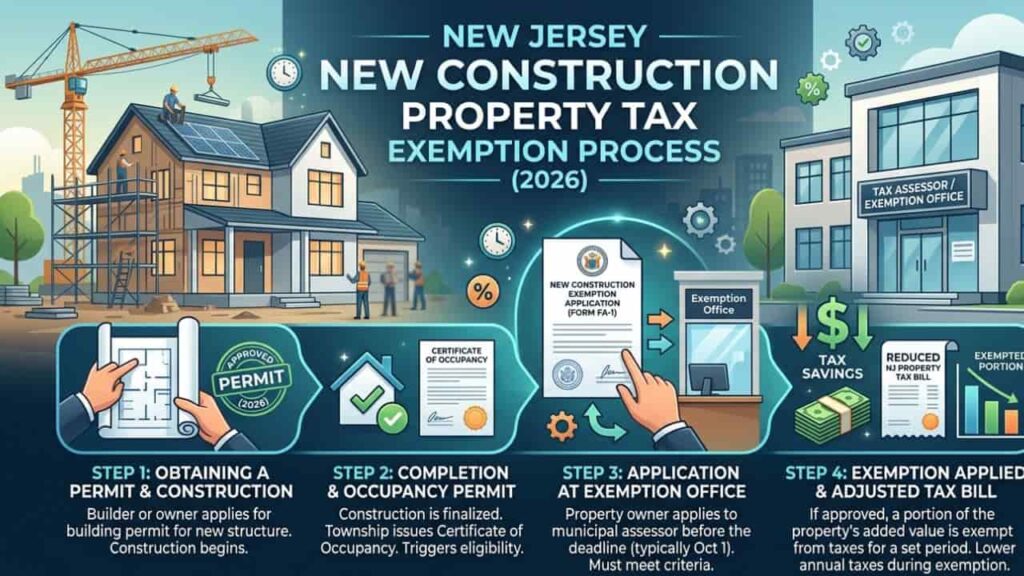
The Filing Process of Form RTF-1 and the Deed
To claim this exemption at closing, specific paperwork must be annexed to the deed before it is presented to the County Clerk or Registrar.
Step 1. The “New Construction” Header
The words “NEW CONSTRUCTION” must be clearly printed in upper case lettering at the top of the first page of the deed. Failure to do this is a common reason for the County Clerk to reject the deed or charge the full tax rate.
Step 2. Completing Form RTF-1
The Affidavit of Consideration (RTF-1) is the official document where you declare your eligibility for the partial exemption.
- Instruction #8
You must check the box for “New Construction”. - Grantor’s Affidavit
The builder/developer (grantor) must sign the affidavit, swearing under oath that the property is an entirely new improvement.
Step 3. Verification of Consideration
The total “Consideration” (sale price) must be stated precisely. This includes not just the base price of the home, but any upgrades or “builder extras” that are included in the final deed price.
Common Problems and Professional Solutions
| Scenario | Potential Issue | Official Solution |
| Developer Contract | Contract says “Buyer pays all RTF.” | Ensure the RTF-1 Form is filed to apply the Partial Exemption so you only pay the reduced rate. |
| Model Home Sale | Was used as an office for 1 year. | If it was “previously used,” it might not qualify. Consult your attorney to verify “Occupancy” status. |
| Price Over $1M | Confusion with “Mansion Tax.” | The Graduated Percent Fee (1% to 3.5%) still applies if the price is over $1M, regardless of the new construction status. |
Why Builders and Developers Matter
In New Jersey, many large scale developers (like Lennar or K. Hovnanian) often shift closing costs to the buyer. If you are buying a property in a new development in Monroe Township or Bridgewater, the developer’s attorney will typically prepare the RTF-1. However, it is your responsibility as the buyer (or your attorney’s) to ensure the “New Construction” box is checked to avoid overpaying the state.
Summary of Maximizing Your New Home Investment
Buying new construction in 2026 is a significant milestone, but don’t let the technicalities of the Realty Transfer Fee catch you off guard. By ensuring the deed is correctly marked and the RTF-1 form is annexed, you capitalize on one of the few direct tax exemptions available to New Jersey home buyers. Always coordinate with yourreal estate attorney to confirm that the “Partial Exemption” is applied, protecting your closing day “Net Proceeds.”
Conclusion
Understanding a 2026 new construction purchase requires technical precision with the RTF-1 form. By ensuring your deed is properly labeled “NEW CONSTRUCTION” and verifying the developer’s affidavit, you can successfully claim a partial exemption from the Realty Transfer Fee. This specialized tax relief ensures that first time and luxury buyers alike retain more of their investment at the closing table.
FAQs
Does “New Construction” mean I don’t pay property taxes for a year?
No. You will still pay property taxes based on the local assessment. This exemption only applies to the Realty Transfer Fee paid at the time of purchase.
What is the “Added Assessment” for new homes?
When you buy a new home, the town will eventually send an “Added Assessment” bill to cover the value of the new structure that wasn’t included in the previous year’s land only assessment.
Can a “flipped” house qualify as new construction?
No. To qualify, the improvement must be entirely new. A renovated or “gutted” home does not meet the statutory definition.
Is the $1 Million Graduated Fee (Mansion Tax) waived for new homes?
No. If your new construction home costs more than $1,000,000, you are still liable for the Graduated Percent Fee on top of the reduced RTF.
What if the builder refuses to sign the RTF-1?
The builder (Grantor) is legally required to sign the Affidavit of Consideration if they are claiming the property is new construction to the state. Your attorney should handle this during the closing process.