For years, the term “Mansion Tax” was a standard part of the New Jersey real estate vocabulary, usually representing a 1% fee paid by the buyer. However, as of 2026, the landscape has fundamentally shifted. The “Mansion Tax” has been replaced by the Graduated Percent Fee (GPF), moving the financial burden and introducing a tiered rate system that every seller must understand before hitting the market. Whether you are selling a luxury estate in Alpine or a high end condo in Jersey City, the distinction between the standard Realty Transfer Fee (RTF) and the new Graduated Percent Fee is the difference between an accurate net sheet and a multi thousand dollar surprise at the closing table.
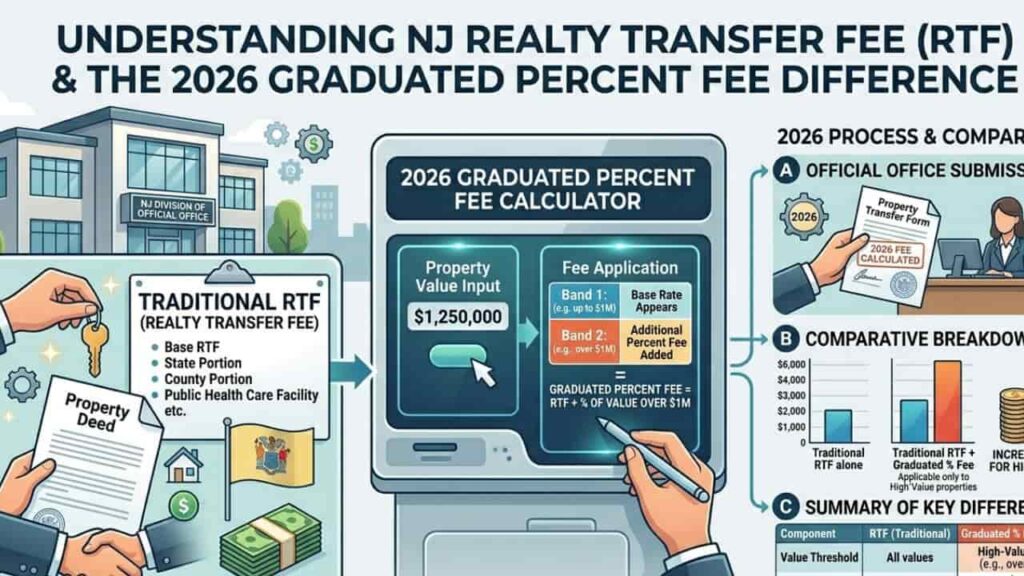
1. The Standard Realty Transfer Fee (RTF)
The Realty Transfer Fee (RTF) is New Jersey’s long standing tax on the recording of deeds. It was established to offset the costs of tracking land transfers and is almost always the seller’s responsibility.
How the RTF is Calculated
The RTF is not a flat tax; it is calculated based on the “consideration” (sale price) mentioned in the deed. For properties over $350,000, the rate includes a State portion, a County portion, and a Supplemental fee.
- Total RTF Components. State + County + Supplemental + General Purpose Fees.
- Exemptions.
Partial exemptions exist for senior citizens (62+), blind persons, or disabled persons, which can lower the rate significantly if filed correctly via Form RTF 1.
2. The Shift From Mansion Tax to “Graduated Percent Fee“
The most critical update for 2026 is the transformation of the 1% “Mansion Tax” into the Graduated Percent Fee (GPF). This change, which went into effect in July 2025 and is fully operational for the 2026 fiscal year, includes two massive shifts. Liability Shift, The buyer no longer pays this fee. It has officially shifted to the SELLER.
Rate Shift. It is no longer a flat 1%. It is now a graduated scale that can go as high as 3.5% for ultra luxury properties.
2026 Graduated Percent Fee (GPF) Rates
Unlike the RTF, which applies to all sales, the GPF only triggers when the sale price exceeds $1,000,000. The rate applies to the entire purchase price, not just the amount over the threshold.
| Sale Price Range | 2026 GPF Rate | Primary Payer |
| $0 – $1,000,000 | $0 (Exempt) | N/A |
| $1,000,001 – $2,000,000 | 1.0% | Seller |
| $2,000,001 – $2,500,000 | 2.0% | Seller |
| $2,500,001 – $3,000,000 | 2.5% | Seller |
| $3,000,001 – $3,500,000 | 3.0% | Seller |
| Over $3,500,000 | 3.5% | Seller |
3. RTF vs GPF, Key Comparison
Sellers often ask “If I pay the RTF, do I still pay the Graduated Fee?” The answer is Yes. They are separate fees collected at the same time.
Comparison Table. Seller Obligations
| Feature | Realty Transfer Fee (RTF) | Graduated Percent Fee (GPF) |
| Applies To | All Real Estate Sales | Sales over $1,000,000 |
| Payer | Seller | Seller (Changed in 2025/2026) |
| Calculation | Complex tiered formula | Flat percentage of total price |
| Average Cost | $10 per $1,000 of value | 1% to 3.5% of total value |
4. The “Seller’s Strategy” for Luxury Properties
Because the GPF applies to the entire purchase price, a small difference in the sale price can lead to a massive jump in taxes. This is known as the “Tax Cliff.”
The $2 Million Cliff Example.
- Sale Price $2,000,000. The rate is 1%. GPF = $20,000.
- Sale Price $2,000,001. The rate jumps to 2%. GPF = $40,000.02.
- The Result. Selling for just $1 more costs the seller an extra $20,000 in taxes.
Professional sellers and their attorneys now frequently negotiate prices to stay just under these tier breaks to maximize net proceeds.
Step by Step. How to Calculate Your Total Closing Tax
- Determine your base RTF.
Use an official 2026 RTF Calculator to find the standard fee based on your county and sale price. - Check the $1M Threshold.
If your price is $1,000,000 or less, your GPF is $0. - Apply the Tier
If over $1M, multiply your total sale price by the applicable GPF percentage from the table above. - Combine the Fees.
Add the RTF and GPF together. This total must be paid (usually by the title company from your proceeds) before the deed can be recorded at the County Clerk’s office.
Common Pitfalls and Expert Solutions
| Issue | Resolution |
| Contract Language | Old contracts might still list the “Mansion Tax” as a buyer expense. Ensure your 2026 contracts reflect the seller’s legal liability for the GPF. |
| Co op Sales | Cooperatives are now explicitly included in the GPF rules for 2026. Sellers of high value co ops in Fort Lee or Hudson County must factor this in. |
| Commercial Sales | “Class 4A” commercial properties are also subject to this fee shift, which significantly impacts commercial ROI. |
Summary. Understanding the 2026 Luxury Market
The transition from a flat, buyer paid Mansion Tax to a graduated, seller paid fee is one of the most significant changes to New Jersey real estate in decades. For sellers, this means that “Closing Costs” are no longer just about commissions and attorney fees. By understanding the Graduated Percent Fee tiers and the underlying RTF structure, you can price your home strategically and ensure your financial planning is based on 2026 reality, not outdated rumors.
Conclusion
Successfully closing a luxury sale in 2026 requires a clear understanding of the Graduated Percent Fee. As the liability has shifted from buyer to seller, accurately calculating your RTF and GPF tiers is essential for protecting your equity. Use our 2026 NJ Closing Cost Calculator to stay ahead of these legislative updates and ensure a smooth transfer of title.
FAQs
Is the Mansion Tax still in effect in 2026?
Technically, it has been renamed and expanded. The 1% fee buyers used to pay is gone; it is now the Graduated Percent Fee paid by the seller at rates between 1% and 3.5%.
Does the seller pay the GPF on commercial property?
Yes. For most “Class 4A” commercial properties over $1,000,000, the seller is now responsible for the graduated fee.
Can the buyer still agree to pay this fee?
Legally, the state holds the seller liable. However, the parties can contractually agree to have the buyer reimburse the seller, though this must be clearly stated in the sales contract.
Is there a refund if I was under contract before the law changed?
There was a limited refund window for contracts signed before July 10, 2025, that recorded by November 15, 2025. For almost all 2026 transactions, the new rules apply fully without refund options.
Are there any exemptions for the Graduated Percent Fee?
Exemptions are rare but include certain transfers between family members for nominal consideration, or transfers involving government agencies. Consult an attorney for specific “Form RTF 1EE” exemptions.