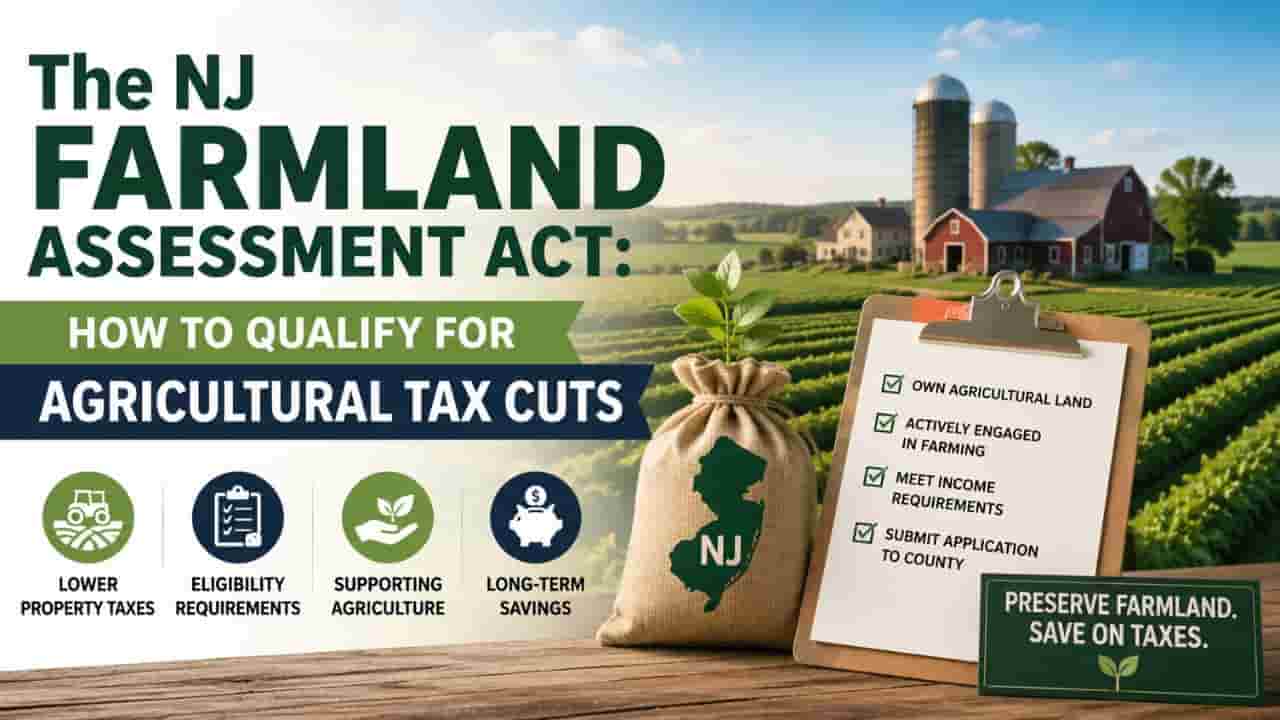
New Jersey may be known for its bustling suburban corridors, but its historic title as “The Garden State” is backed by a powerful piece of tax legislation. The Farmland Assessment Act of 1964. For property owners in semi rural and suburban stretches such as Hunterdon, Burlington, Monmouth, and Sussex counties holding raw acreage can become a massive liability due to New Jersey’s high property tax rates.
However, landowners possessing five or more contiguous acres can slash their municipal property tax obligations by 90% or more. This tax relief is unlocked by shifting the property from standard market value taxation to an assessment based purely on agricultural productivity.
Complying with the strict compliance metrics set by the New Jersey Division of Taxation requires a clear, step by step approach to meet the agricultural criteria and avoid severe rollback penalties.
Core Eligibility Criteria for Farmland Assessment
Qualifying for agricultural tax relief in New Jersey is not as simple as letting your grass grow or placing a small vegetable garden in your backyard. The state enforces precise statutory conditions that a property must fulfill before a municipal tax assessor can grant a preferential valuation.
The 5 Acre Minimum Threshold
To be considered for farmland status, your property must contain a minimum of five contiguous acres actively devoted to agricultural or horticultural operations.
Important Real Estate Note. The land sitting directly underneath your farmhouse, along with the immediate residential yard, driveway, and swimming pool (collectively called the “curtilage”), is completely excluded from this five acre calculation. This residential portion continues to be assessed at full market value. Therefore, if you own exactly five acres but have a home on the property, you will not meet the land area minimum.
The Two Year Active Devotion Rule
Your land must be actively used for approved agricultural or horticultural practices for two consecutive years immediately preceding the tax year you claim the benefit. If you buy raw land that has never been farmed, you must manage it as an active agricultural unit for two calendar years at standard tax rates before the lower productivity rates take effect in the third year.
Production Categories and Income Thresholds
The state allows a variety of farming styles to qualify for tax reductions, but each category must meet strict gross sales rules. Public Law 2013, Chapter 43 updated these regulations to raise the baseline income targets and prevent hobbyists from abusing the system.
Standard Agricultural vs Woodland Requirements
For field crops, vegetables, orchards, or livestock operations, the property must generate a specific dollar amount in gross sales. If your property contains non appurtenant woodland (forested land that does not support regular crops), you must establish a formal Woodland Management Plan approved by the New Jersey Department of Environmental Protection (NJDEP) State Forester.
The statutory minimum income structures scale depending on your exact total acreage.
| Acreage Classification | Mandatory Farm Use Type | 2026 Minimum Annual Gross Sales Requirement |
| First 5 Acres Baseline | Standard Cropland / Livestock | $1,000 baseline per year |
| First 5 Acres Baseline | Approved Woodland Management | $500 baseline per year |
| Every Additional Acre (Over 5) | Standard Cropland / Livestock | $5.00 additional per acre per year |
| Every Additional Acre (Over 5) | Approved Woodland Management | $0.50 additional per acre per year |
What Counts Toward Gross Sales?
Landowners can meet these financial benchmarks by selling field crops, timber, syrup, livestock products, or by collecting official boarding, training, or rehabilitation fees for equine (horse) operations. It is critical to note that rental income paid to you by a tenant farmer does not count toward the gross sales requirement. The actual products generated from the dirt must hit the market value thresholds.
Step by Step Guide to Securing Farmland Status
If your land meets the physical size and production metrics, you must move through the strict annual regulatory submission cycle. Missing a deadline or omitting forms results in an immediate denial.
[Maintain 2 Years of Active Farming] ➔ [File Forms FA-1 & FA-1 G.S. by August 1] ➔ [Assessor Field Inspection] ➔ [November 1 Status Decision]
Step 1. Document Your Farming History
Gather clear proof of your farming activities over the past two years. Keep detailed records of receipts, sales ledgers, matching commercial contracts, or statements from tenant operators detailing specific crop yields and wholesale or retail distribution.
Step 2. Complete the Official Statutory Application Forms
Every calendar year, you must fill out two core documents.
- Form FA-1 (Application for Farmland Assessment)
This tracks your current land use classes, dividing your property into precise categories like cropland harvested, cropland pastured, appurtenant woodland, or wetland. - Form FA-1 G.S. (Supplemental Farmland Assessment Gross Sales Form)
This acts as your official certification of income. Under New Jersey law, signing this form is considered an oath subject to perjury penalties, and intentional misrepresentation carries a civil fine of up to $5,000.
Step 3. Handle Small Property Protocols (Farms Under 7 Acres)
If your active farm unit is larger than the five acre minimum but smaller than seven acres, state administrative code requires you to submit a highly detailed descriptive narrative and a clear activity map each year. This map must pinpoint the exact locations of seasonal planting, livestock grazing areas, or beehives so the assessor can cross reference your claims during field evaluations.
Step 4. Submit by the August 1st Statutory Deadline
You must file duplicate copies of your completed paperwork with your municipal tax assessor on or before August 1st of the pre tax year. Late or incomplete submissions are automatically rejected by law, with no options for retrospective adjustments.
The Danger of Rollback Taxes
The Farmland Assessment Act is designed to preserve open space and agricultural production across New Jersey, not to serve as a temporary tax shelter for real estate developers. To protect this intent, the state enforces a strict financial penalty known as a Rollback Tax when farmland is converted to non agricultural use.
How Rollback Calculations Work
If you change the use of your land such as clearing a qualifying orchard to construct a commercial warehouse or a multi family housing development the municipality will calculate the difference between the low agricultural tax you paid and the full market value tax you would have paid.
The owner is legally liable for this tax difference for the year the change takes place, plus the two preceding tax years.
Financial Impact Example
If a 20 acre parcel in a high tax township enjoys a tax reduction from $25,000 down to $1,500 per year, switching to a commercial use triggers an immediate retroactive tax bill. The owner would face a bill covering three total years of tax differences, resulting in a sudden assessment that can easily exceed $70,000. This structural penalty remains tied directly to the land, meaning future buyers must verify a property’s current zoning and usage status during standard real estate due diligence.
Conclusion
The NJ Farmland Assessment Act offers substantial financial relief for property owners willing to maintain genuine agricultural operations. By dedicating at least five contiguous acres to active production, generating the required gross sales, and consistently filing Forms FA-1 and FA-1 G.S. before the strict August 1st deadline, you can protect your land from high market value taxes. However, because compliance standards are strictly enforced and the financial risks of rollback taxes are high, landowners must manage their properties carefully to keep their farm status secure year after year.
FAQs
What is the deadline to file for NJ farmland assessment?
You must file Form FA-1 and Form FA-1 G.S. with your local municipal tax assessor annually on or before August 1st.
How many acres do you need for farmland assessment in NJ?
You need a minimum of five contiguous acres actively devoted to agricultural or horticultural use, excluding the residential home site and yard.
What are the income requirements for NJ farmland assessment?
Farms must generate a minimum of $1,000 in gross sales for the first five acres, plus $5.00 for each additional acre annually.
What happens if I stop farming my NJ tax assessed land?
If you convert the land to non agricultural use, the municipality will level rollback taxes covering the current year plus the two prior years.
Does a woodland management plan qualify you for farmland tax cuts?
Yes. Non appurtenant woodlands can qualify if managed under an approved NJDEP plan, requiring $500 in annual gross sales for the first five acres.
Can horse boarding help a property qualify for agricultural tax status?
Yes. Fees collected for boarding, training, or rehabilitating livestock can count toward the gross income requirement if the facility is contiguous to qualifying land.
Does land under a solar array qualify for farmland assessment?
Solar energy generation facilities can qualify under strict limits. The array must cover 10 acres or less and maintain a 1 to 5 ratio of energy land to active agricultural operations.