For those who have served in the United States Armed Forces, New Jersey offers some of the most robust property tax relief programs in the country. As we enter the 2026 tax year, staying informed about current statutory deductions and full exemptions is vital for maintaining your financial health in the Garden State. This guide provides a professional, step by step breakdown of the $250 Veteran Deduction and the 100% Disabled Veteran Property Tax Exemption. Whether you are an honorably discharged veteran in Burlington County or a surviving spouse in Monmouth County, this authoritative guide covers the technical requirements, filing deadlines, and official documentation needed to secure your benefits.
New Jersey’s Two Tiered Veteran Tax Relief System
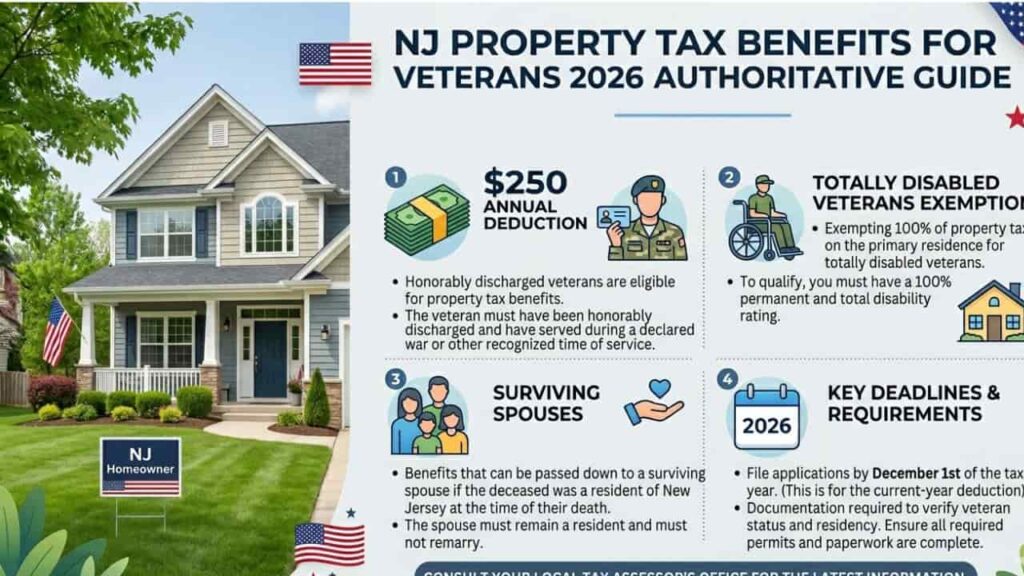
New Jersey distinguishes between a standard annual deduction and a total exemption. While the $250 deduction is available to most wartime veterans, the full exemption is strictly reserved for those with a 100% permanent and total service connected disability.
2026 Veteran Relief Comparison Table
| Benefit Type | Amount (Annual) | Primary Qualification | Mandatory Form |
| Veteran Deduction | $250 | Honorable Wartime Service | Form V.S.S. |
| Disabled Veteran Exemption | 100% Tax Free | 100% P&T Disability | Form D.V.S.S.E. |
| Surviving Spouse Benefit | Same as above | Non remarried status | Relevant form + DD-214 |
1. The $250 Veteran Property Tax Deduction
The $250 Veteran Deduction is an annual subtraction from your property tax bill. To qualify for the 2026 cycle, you must meet stringent residency and service requirements as of the pre tax year (October 1, 2025).
Eligibility Requirements
- Service
You must have been honorably discharged from active duty during a recognized “time of war” or specified peacekeeping mission. - Residency
You must be a legal resident of New Jersey and own the property for which the deduction is claimed. - Surviving Spouses
The unmarried surviving spouse of a qualified veteran is also eligible, provided the veteran was a NJ resident at the time of death.
Application Deadline
For 2026, the application (Form V.S.S.) must be filed with your local Municipal Tax Assessor. While you can file any time during the year, it is best practice to submit by December 31st to ensure the deduction appears on your following year’s tax bill.
2. The 100% Disabled Veteran Property Tax Exemption
This is New Jersey’s most powerful tax benefit. Qualified veterans are granted a full property tax exemption on their principal residence and the lot on which it sits.
Technical Qualifications for Total Exemption
To secure a 100% exemption in 2026, the following criteria are non negotiable.
- VA Certification
You must provide a U.S. Department of Veterans Affairs (VA) letter stating you have a 100% permanent and total (P&T) service connected disability. - Occupancy
The property must be your principal residence. Vacation homes or investment properties are strictly ineligible for this exemption. - Wartime Service
Your disability must have been sustained during active wartime service or an approved peacekeeping mission.
Form D.V.S.S.E. Documentation Checklist
To file your claim effectively, you must provide the following “Documentary Proof” to your Tax Assessor.
- Military Records (DD-214). Showing honorable discharge and wartime service dates.
- VA Disability Award Letter. Confirming 100% P&T status.
- Property Deed. Proving ownership.
- NJ Driver’s License. Proving residency.
Surviving Spouses, Maintaining Your Benefits
A common concern in New Jersey is whether a surviving spouse loses these benefits upon the veteran’s passing. The law provides continuous protection under specific conditions.
- Non Remarriage
- The spouse must remain unmarried and continue to occupy the home as their principal residence.
- Residency
- The deceased veteran must have been a legal resident of New Jersey at the time of their death.
- Serviceperson Death
- Spouses of servicepersons who died on active wartime duty are also eligible for the full 100% exemption.
Common Filing Obstacles and Solutions
| Problem | Official Solution |
| Lost DD-214 | Contact the NJ Dept. of Military and Veterans Affairs at 609-530-6958 for a certified copy. |
| Partial Ownership | If you own the home with a non spouse, the deduction/exemption may be prorated based on your percentage of ownership. |
| Application Denied | You have the right to appeal. File Form A-1 with the County Board of Taxation on or before April 1st. |
Summary, Maximizing Your Service Benefits
New Jersey’s property tax benefits are a sign of gratitude for your service. In 2026, whether you are claiming the $250 deduction or the 100% exemption, the key to a successful application is providing clean, official documentation. By filing Form V.S.S. or Form D.V.S.S.E. early, you ensure your status is recognized by the municipal assessor, protecting your home and your financial legacy.
Conclusion
Securing your 2026 NJ veteran tax benefits requires meticulous attention to wartime service dates and VA certification. Whether applying for the $250 annual deduction via Form V.S.S. or the 100% permanent disability exemption via Form D.V.S.S.E., veterans and surviving spouses must act before the municipal deadlines. Always verify your DD-214 and residency status to ensure your service is honored with the full measure of relief provided by New Jersey law.
FAQs
Can I get both the Veteran Deduction and the Senior Citizen Deduction?
Yes. If you meet the age and income requirements for the Senior Citizen deduction ($250) and also qualify as a veteran, you can receive both, totaling $500 in annual deductions.
Does my 100% disability have to be from combat?
The disability must be “service connected” and sustained during a wartime period, but it does not necessarily have to be from direct enemy action.
When does the 100% exemption take effect?
In most New Jersey municipalities, the exemption becomes effective on the date the application is filed with the assessor, or as soon as the 100% P&T status is granted by the VA.
Is there an income limit for the $250 Veteran Deduction?
No. Unlike the Senior Citizen deduction, the Veteran Deduction does not have a gross income limit.
What if I am a “non wartime” veteran?
Currently, New Jersey law requires service during a specific “time of war” for these property tax benefits. However, keep an eye on 2026 legislative sessions, as there are ongoing discussions to expand eligibility.